The Sales Skills That Will Matter Most in 2026
Explore how an AI sales training platform helps develop essential sales skills in 2026, from active listening, judgment to building trust.
4 min
Trovex Team4 min read
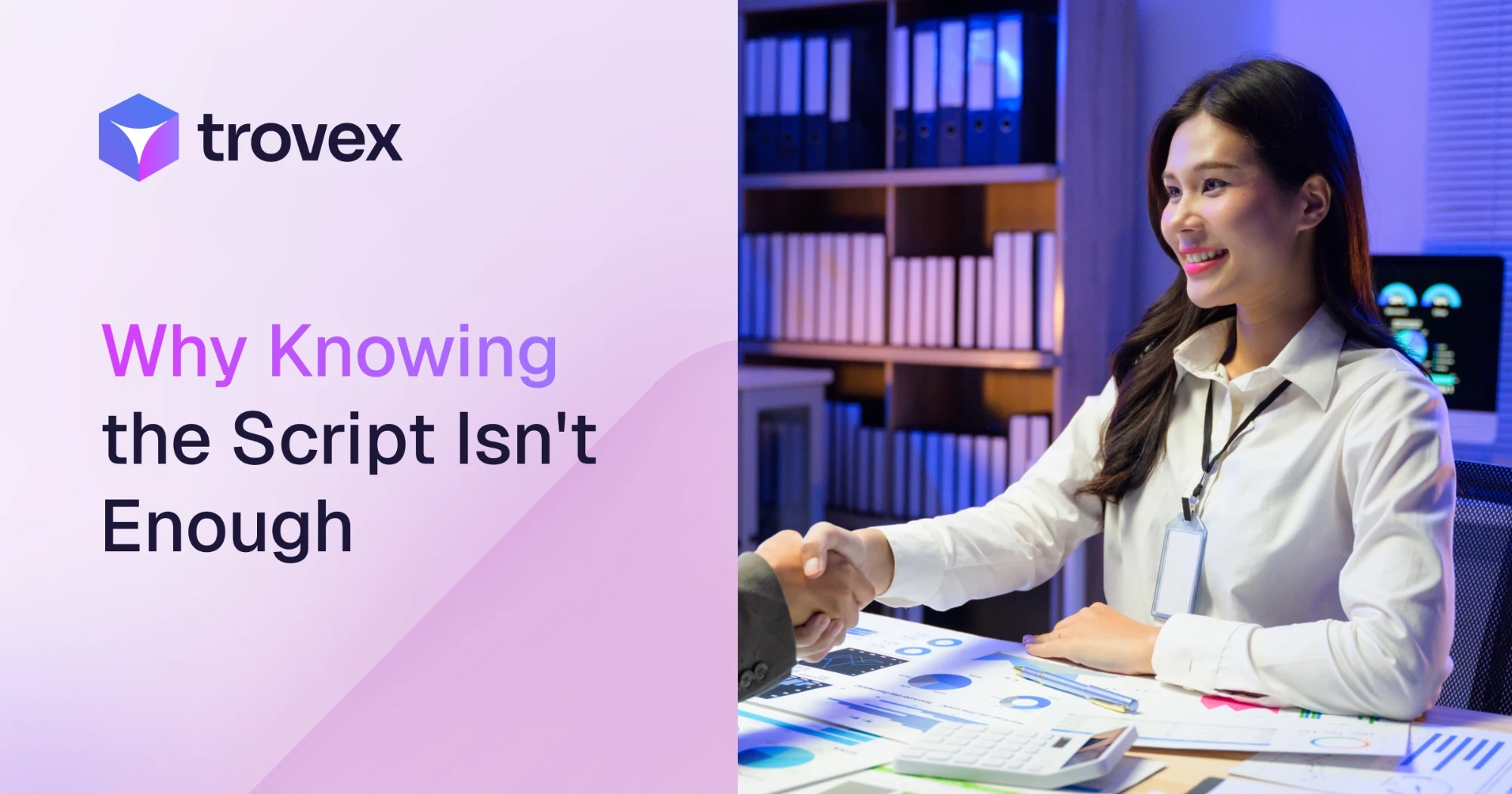
Sales conversations rarely follow a script. A buyer may question pricing, challenge the value proposition, compare providers, or introduce an unexpected concern. In these moments, knowing the approved response is useful, but knowing when and how to adapt it is what matters.
Traditional sales training often teaches representatives to recognize common objections and respond with predefined answers. Modern buyers, however, expect salespeople to understand context, ask relevant questions, and respond to the concern behind the words. This is where AI sales roleplay can help reps practise conversations that require judgment rather than memorization.
Sales scripts provide structure. They help new representatives understand messaging, maintain consistency, and avoid missing important information. The challenge begins when a script becomes a substitute for understanding the buyer.
Consider a prospect saying, “Your solution is too expensive.” That statement could indicate a genuine budget limitation, an unclear business case, weak perceived value, or comparison with a cheaper alternative.
The words are the same, but the underlying concern can be completely different. Effective objection handling therefore requires diagnosis before response. An AI sales roleplay environment can expose reps to different interpretations of the same objection, helping them practise how their response should change according to context.
One objection can represent several different buyer concerns.
Adaptive selling does not mean abandoning sales frameworks. It means applying them intelligently. A representative may have a proven approach for pricing objections, but the response should change depending on whether the buyer is concerned about budget, ROI, procurement pressure, or risk.
AI sales roleplay can recreate these variations by introducing different buyer behaviours and follow-up questions. Instead of simply remembering what to say, reps practise identifying what the buyer actually needs.
Effective practice should encourage representatives to:
This capability also matters during negotiation, where buyers may challenge pricing, compare alternatives, question commercial terms, or test how confidently a salesperson can defend value.
There is a significant difference between knowing what to say and being able to say it when a conversation becomes unpredictable. Training rooms can teach frameworks, while playbooks can provide approved messaging. Real customer conversations introduce interruptions, uncertainty, skepticism, and unexpected follow-up questions.
This is why AI sales roleplay becomes more useful when practice reflects those realities. Buyers can challenge assumptions, change direction, become impatient, or introduce new concerns. Reps can then practise adapting without the pressure or consequences of a live customer interaction.
A structured sales readiness assessment can complement this practice by evaluating how consistently representatives apply the required behaviours. Rather than measuring only whether training was completed, organisations can examine how effectively reps handle realistic situations.
Sales readiness is not simply about completing courses or remembering product information. It is about whether representatives can apply what they know during customer conversations.
A sales readiness assessment can help organisations evaluate areas such as objection handling, discovery, communication, product knowledge, and adaptability. When combined with AI sales roleplay, the assessment process can provide a clearer picture of how representatives respond when conversations become difficult.
The value becomes greater when a sales readiness assessment is used repeatedly rather than as a one-time checkpoint. Managers can identify specific gaps, assign relevant practice, and reassess progress over time.
This creates a more continuous approach to development. Instead of waiting for performance issues to appear in customer conversations, teams can use AI sales roleplay to practise difficult situations and use a sales readiness assessment to understand where additional development is required.
Scripts still have a place in modern sales training. They establish core messaging, communicate product information, and provide new representatives with a reliable starting point. The mistake is treating the script as the finish line. The goal of AI sales roleplay is not to help reps memorize more conversations. It is to help them become comfortable navigating conversations they cannot fully predict.
Trovex brings this approach together through realistic AI simulations, varied buyer personas, feedback, and structured evaluation. Reps can practise independently, receive feedback, and attempt challenging conversations again. A sales readiness assessment can then help identify whether those practice sessions are translating into stronger behaviours.
When AI sales roleplay and a sales readiness assessment become part of an ongoing readiness process, sales teams can move beyond training completion toward continuous application and improvement.
The question sales leaders should ask is no longer, “Does the rep know the answer?” It is: “Can the rep understand the concern, adapt the conversation, and respond effectively when the situation changes?”
That is the difference between knowing a script and being sales-ready.
The best approach is to listen first, clarify the underlying concern, acknowledge it, and respond with relevant value. Reps should avoid immediately delivering a memorized answer. Focused questions can reveal whether the issue involves price, timing, risk, authority, product fit, or another business constraint before recommending a solution. AI sales roleplay can help representatives practise identifying and responding to these different concerns.
Sales scripts cannot account for every buyer, situation, personality, or hidden concern. Two buyers can use identical words while communicating completely different problems. Scripts provide useful structure, but effective selling also requires active listening, contextual judgment, and the ability to adapt the conversation based on what the buyer reveals.
Sales reps can practise through realistic simulations involving different buyers, scenarios, personalities, and follow-up questions. Repetition builds familiarity, while feedback improves execution. Reviewing missed signals and weak responses, then repeating challenging conversations, helps representatives turn frameworks and product knowledge into practical conversational skills they can use confidently. A sales readiness assessment can also help identify areas where additional practice is needed.
Common B2B sales objections include pricing, budget limitations, implementation effort, existing solutions, switching risk, security concerns, integration requirements, procurement processes, timing, and uncertainty around business value. However, the stated objection may not be the actual barrier, making discovery and clarification essential before a salesperson attempts to address it. AI sales roleplay can expose reps to a wider range of these scenarios.
AI can create repeatable buyer simulations that vary personalities, scenarios, questions, and conversational behaviour. This allows representatives to practise without depending entirely on manager availability or live customers. AI-driven feedback can also identify recurring communication gaps, giving reps targeted opportunities to improve their responses before important customer conversations. A sales readiness assessment can complement this practice by measuring how effectively representatives apply those skills.
Managers should evaluate more than whether a representative used the approved response. Useful indicators include listening quality, discovery questions, relevance, confidence, handling of follow-up challenges, clarity, and the ability to move the conversation forward. Measuring these behaviours provides a better picture of whether training is translating into sales performance. A sales readiness assessment can help structure this evaluation consistently.
 Sales Skills
Explore how an AI sales training platform helps develop essential sales skills in 2026, from active listening, judgment to building trust.
4 min
 Sales Coaching
Discover why continuous coaching and practice are replacing traditional sales training to improve sales readiness and performance.
6 min
 Sales Training
Discover how AI sales roleplay creates realistic practice that helps reps handle buyer challenges, build confidence, and improve real-world performance.
4 min